AI has made it remarkably easy to produce a competent article about almost anything.
That is useful. It is also changing the competitive value of competent articles.
When every business can publish a reasonable explanation in minutes, simply adding more words to the internet becomes less differentiating. The article is not dead. Good writing, original reporting, real experience, and a clear point of view still matter.
But generic information is becoming abundant.
Useful judgment is not.
That is why the rise of micro magnets matters. As Part 1 of this series explains, a micro magnet is a small digital experience—such as a calculator, assessment, diagnostic, recommender, planner, or learning tool—that helps a person do something with the expertise of a business.
The difference is simple.
An article can claim that a business understands a difficult decision. A useful interactive experience can demonstrate how that business thinks about it.
Demonstrated expertise is harder to imitate
Generic content often follows a predictable pattern: define the problem, list a few tips, summarize the benefits, and end with a call to action.
AI can help produce that pattern all day.
A useful tool asks more of the publisher. The business has to decide which questions matter, which inputs change the answer, what assumptions are reasonable, where uncertainty should be shown, and when the tool should tell the user to speak with a human.
Those choices reveal expertise.
A roofing company that builds a repair-or-replace estimator must know which factors actually influence the decision: roof age, material, damage pattern, leak history, local weather, and the relationship between short-term repair cost and remaining useful life. The tool does not need to quote a final contract price. It can help the homeowner understand the decision before the inspection.
A realtor's relocation readiness assessment can account for timing, financing, school or commute priorities, tolerance for temporary housing, and the number of decisions a household has already made. That is more useful than another post titled "Ten Tips for Moving to a New City."
The tool contains a point of view about what matters.
Recurring questions are product clues
Most expert businesses already possess the raw material for interactive publishing. It sits inside sales calls, discovery meetings, estimates, onboarding conversations, internal spreadsheets, and the questions customers ask repeatedly.
An AI consultant may hear, "Are we ready for AI?" The honest answer is rarely a yes or no. Readiness depends on process clarity, data quality, ownership, risk, staff capability, and whether the business has a valuable problem to solve. Those dimensions can become an AI readiness diagnostic.
A financial professional may repeatedly compare scenarios involving contribution levels, time horizons, or cash-flow tradeoffs. With appropriate disclosures and human review, a scenario calculator can help clients prepare better questions without pretending to replace professional advice.
An educator may explain the same abstract concept from five different angles. A short interactive lesson or game can let learners test the idea, make a choice, see the consequence, and try again.
The point is not to turn every conversation into code. It is to notice when a repeated explanation contains a stable structure that an audience could use.
The first-party insight may be as valuable as the visit
Traditional content analytics tell a business that someone viewed a page, watched part of a video, or clicked a link.
An interactive experience can reveal a more useful kind of intent—provided the business handles the data responsibly and explains what it collects.
Which scenario did people calculate most often? Where did assessment scores cluster? Which recommendation did people request? Which question caused users to stop? Which planning priority kept appearing?
Those interactions are not merely leads. They are evidence about what the market is trying to understand.
A repair-or-replace estimator may show that homeowners are less worried about total cost than uncertainty around urgency. An AI readiness diagnostic may reveal that leadership interest is high while process ownership is weak. A relocation planner may show that timing creates more anxiety than neighborhood selection.
That is first-party insight: knowledge created through a direct interaction between the business and its audience, rather than borrowed from a platform's general trend report.
It can improve both the tool and the surrounding content.
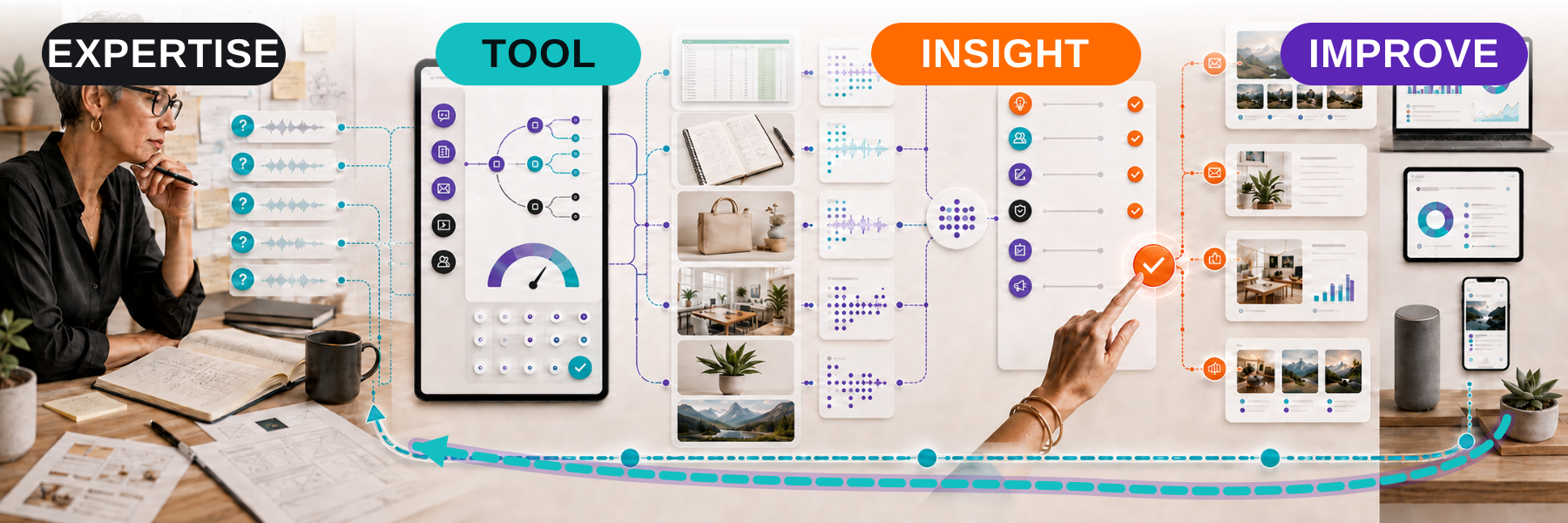
The micro-magnet flywheel
The strategic value becomes clearer when the tool is not treated as a one-off campaign asset.
The operating loop looks like this:
1. Business expertise. Start with a recurring problem the company understands through real work. 2. Useful micro application. Package one part of that judgment into an estimator, diagnostic, planner, recommender, or learning experience. 3. Customer interaction. Let the audience explore its own situation instead of only reading a general answer. 4. New insight. Learn which questions, inputs, misunderstandings, and desired outcomes appear most often. 5. Better content. Use those patterns to create sharper articles, emails, videos, sales materials, and explanations. 6. Better tools. Improve the interactive experience using what the business has learned. 7. Stronger authority. Become known not simply for publishing frequently, but for helping people think more clearly.
Then the loop repeats.
This is a better use of AI than flooding the market with interchangeable copy. AI can reduce production friction, help organize patterns, assist with development, and prepare revisions. The valuable input remains the business's knowledge and judgment.
Discovery is changing too
Search engines, answer engines, social platforms, and personal AI assistants are all becoming ways people ask for information. That means a business cannot assume every discovery journey begins with someone browsing a blog archive.
Clear, well-structured articles still give machines and humans useful context. Interactive tools add something different: a destination worth visiting because the person needs to use it.
An AI answer may summarize the basics of calculating project payback. It cannot automatically apply a particular firm's carefully chosen assumptions to a visitor's situation unless a useful experience exists to do that work.
In an information-rich market, utility gives people a reason to leave the summary and engage with the source.
Start before this becomes standard practice
Micro magnets will not stay unusual. As the cost of development falls, more businesses will add calculators, assessments, and guided experiences to their publishing mix.
The advantage now is not novelty for novelty's sake. It is learning how to convert expertise into safe, useful interactions while the practice is still emerging.
Businesses that start early can learn what their audience values, develop a repeatable review process, and build a library of owned interactive assets. Businesses that wait may eventually build similar tools, but they will begin without the operating experience or first-party insight accumulated along the way.
Where StoryShellOS fits
StoryShellOS is being designed around this broader definition of publishing. The aim is to help businesses turn approved expertise into the format that best serves the audience—articles, email, social content, video, and increasingly small interactive applications.
That does not remove human review. It makes review more important. Assumptions, recommendations, calculations, privacy choices, and public claims all need an accountable owner.
The human provides the expertise. The system helps turn that expertise into useful things.
The takeaway
When information is cheap, usefulness becomes a stronger signal of authority.
The businesses that prepare for the AI-driven publishing world will not merely produce more content. They will create experiences that help people decide, understand, and learn—and they will use those interactions to become more helpful over time.
Part 3 shows how to identify the first micro magnet worth building and make interactive publishing part of the strategy rather than a special experiment.