If an interactive tool only enters the conversation after someone says, "We should build an app," it will usually be treated as a special project.
That usually means an oversized scope and months of delay while the content calendar keeps asking for another article.
There is a better way to think about it.
Interactive publishing belongs inside the content strategy from the beginning.
As Part 1 and Part 2 established, a micro magnet is a small, useful digital experience that helps the right audience calculate, assess, diagnose, plan, choose, or learn something connected to the expertise of a business.
The important word is small.
The first micro magnet does not need accounts, dashboards, subscriptions, or a product roadmap. It needs one useful job, clear boundaries, and a reason for the right customer to care.
Do not start by asking what app you can build. Start by asking what useful decision you can help someone make.
Choose the format by usefulness
Content planning often defaults to the format the team already knows. The subject becomes an article because the business publishes articles. It becomes a video because the team has a video process. It becomes a PDF because someone has last year's PDF.
A more useful editorial question is:
What should this piece of expertise become?
- an article?
- a social post?
- a video?
- an email?
- a guide?
- a calculator?
- an assessment?
- a small application?
The answer depends on what the audience needs to do.
Use an article when the reader needs explanation, argument, context, or a point of view. Use video when demonstration, personality, or visual sequence matters. Use email when timing and a direct relationship matter. Use a guide when the audience needs a reliable reference.
Use an interactive format when the value depends on the user's inputs, choices, sequence, or practice.
Not everything should become a blog post.
Look where the work repeats
Good micro-magnet ideas are usually hiding in work the business already performs. Start with places where knowledge repeats but the answer still needs a little judgment.
Questions customers ask repeatedly
If prospects ask the same question in every sales conversation, the answer may have a stable structure. A consultant who repeatedly explains readiness could create a short assessment. A landscaper who repeatedly discusses seasonal timing could create a planning guide that adjusts by property goal and month.
Decisions customers struggle to make
Confusion is often a better opportunity than curiosity. Repair or replace? Start now or wait? Which service level fits? Which sequence reduces risk? A decision tool can clarify the tradeoffs without pretending every answer is universal.
Calculations employees repeatedly perform
Look at the spreadsheets, worksheets, and back-of-the-envelope math used during estimates and discovery. A portion of that logic may be safe and useful to publish as a cost range, savings scenario, capacity planner, or ROI calculator.
Information customers need before buying
Sometimes the best tool does not sell. It prepares. A project-readiness checklist, relocation planner, event-budget builder, or document-gathering assistant can help a prospect arrive at the first conversation with better information.
Common misunderstandings
If customers consistently confuse two services or misread a technical issue, an interactive comparison can let them see how the answer changes based on context.
Internal checklists and diagnostics
Many businesses already have a small application disguised as a worksheet. A good internal checklist contains sequence, conditions, and judgment. With careful editing, it may become an external diagnostic that gives customers a useful first view while keeping sensitive or proprietary logic inside the business.
Training concepts that improve through practice
Some ideas become clear only when a learner makes a choice and sees what happens. That is where a mini simulation, scenario exercise, or simple game can outperform a lecture.
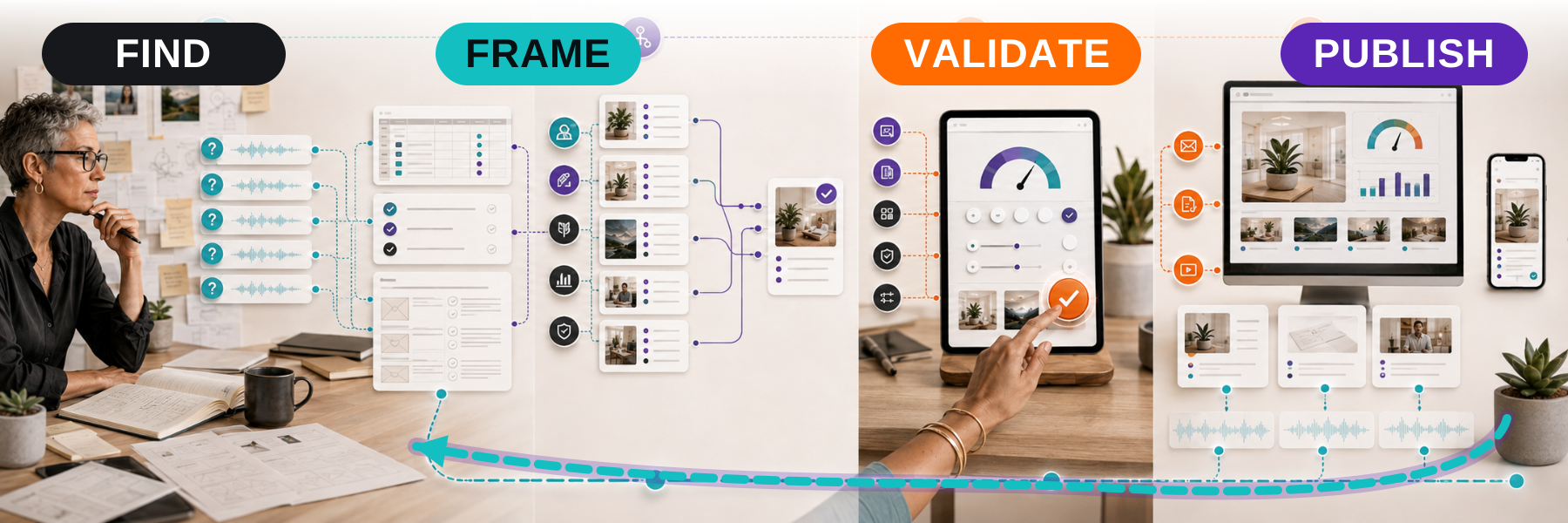
A five-question framework for the first micro magnet
Do not begin with the biggest idea. Begin with the clearest useful one.
1. What repeats?
List the questions, calculations, decisions, recommendations, and explanations that appear most often in sales, service, onboarding, and support. Frequency is evidence that the audience cares.
2. What changes the answer?
Identify the few inputs that genuinely affect the outcome. If a decision requires fifty variables and a professional inspection, the first tool may only prepare the user for that inspection. Narrow the promise until it can be honest.
3. What useful output can you provide safely?
The output might be a range, a readiness band, a prioritized checklist, a suggested next step, or an explanation of tradeoffs. Avoid false precision. State assumptions and limits in plain English, especially in financial, legal, health, or safety-sensitive contexts.
4. Can someone use it in a few minutes?
A micro magnet should respect attention. Ask only for inputs needed to improve the output. Do not turn a useful assessment into a disguised twenty-page intake form. If an email address is optional, say so. If data is stored, explain why.
5. What will you learn after it ships?
Decide which interactions would improve the business's understanding without collecting unnecessary personal information. Repeated selections, common ranges, drop-off points, and frequently requested explanations can guide the next article, sales conversation, and version of the tool.
If the idea passes all five questions, it is probably small enough to prototype and valuable enough to test.
Give the tool an editorial brief
Treat the micro magnet like a published asset, not a side project. Before development begins, write a short brief that names:
- the specific audience
- the decision or learning job
- the expert logic behind the experience
- the inputs required
- the output promised
- the assumptions and limits
- the human responsible for approval
- the next helpful step after the result
- the data the business will and will not collect
This prevents accidental product sprawl and gives AI-assisted development a sound brief instead of asking the system to invent the business logic.
The human provides the expertise. The system helps turn that expertise into useful things.
Publish, observe, and improve
Put it in front of a few real customers or trusted prospects. Watch for confusing language. Check the output against an experienced employee's judgment. Test edge cases, and require human approval before changing recommendations or calculations.
Then surround the tool with the content it naturally creates.
Write the article that explains the assumptions. Record the video that demonstrates how to use the result. Send the email that answers the most common follow-up question. Publish an anonymized pattern the team learned from the interactions.
The tool and the content should make each other better.
Make capacity visible
Interactive tools require more effort than a typical article or social post. They involve product thinking, interface decisions, development, testing, accessibility, and ongoing review.
That is why they should have a deliberate place in a managed publishing plan rather than being treated as free extras. More complex publishing assets may consume a larger share of a client's monthly managed publishing capacity.
The service model can remain flexible. The principle is what matters: choose work by audience value and do not pretend every format costs the same to produce responsibly.
Where StoryShellOS fits
StoryShellOS is being designed as an owned publishing operation for expertise-led businesses. The aim is to help a team capture what it knows, apply human judgment, and publish the result in the format that makes the most sense—articles, email, social content, video, guides, and increasingly small interactive applications.
That is a direction, not a promise that every engagement includes unlimited app development. The purpose is to make interactive publishing part of the strategic menu and give good ideas a governed path from expertise to a useful public experience.
The takeaway
Sometimes your best content is software.
The first step is not a giant app proposal. It is one repeated audience problem, one piece of credible expert logic, and one focused experience that helps someone make progress.
The businesses that prepare for the AI-driven publishing world will not merely produce more content. They will turn their expertise into useful digital experiences.
Spend less time feeding your marketing machine and more time giving it something worth talking about.