
There was a point in NoodleNet's development when its workflows and capabilities began to compound.
Yes, I know. Fancy word.
The less-fancy truth is that I love exploring the relationship between humans and AI. I probably talk about it too much, but I blame science fiction.
Long before any of this was real, interacting with intelligent machines somehow felt normal in those stories. Who knows? Maybe we were being prepared.
That is also why NoodleNet looks like something humans already understand: windows, apps, cards, notes, folders and projects.
The agents do not need any of that.
They are perfectly happy hanging out in the orchestration layer, passing messages, calling tools and doing whatever agents do when the humans are not looking.
The interface is for us.
It gives humans a familiar place to work while we adapt to a very different relationship with technology.
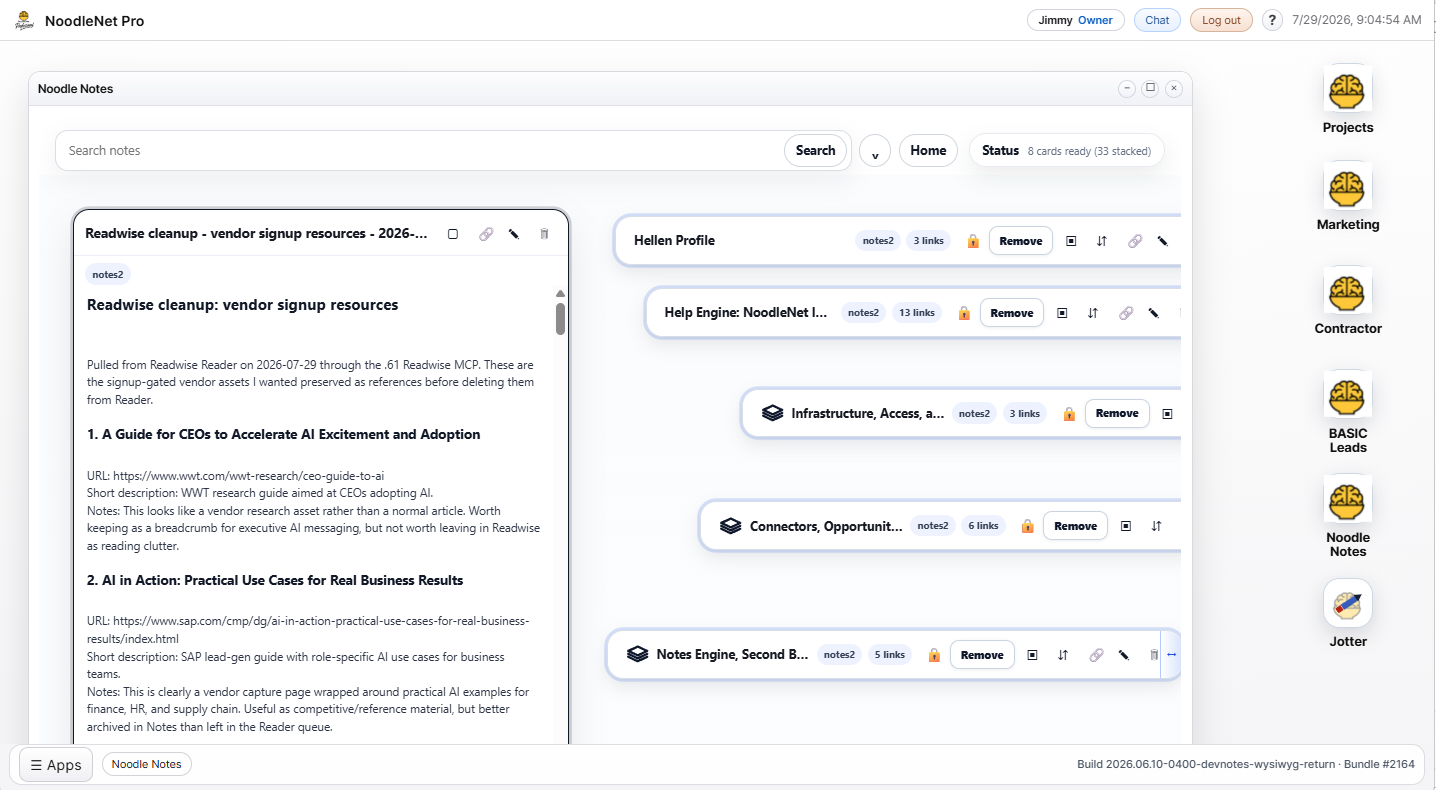
Take what is happening in this screenshot.
On the left is a new memory object created from a cleanup of my Readwise account. On the right is the larger Noodle Notes environment it now lives inside, connected with the rest of my projects, research and agent memory.
This is part of my AI-governed second-brain project. You could call it an app. Some might call it a use case.
I call it a solution.
Feel free to read my other posts about the AI-governed second brain, because that is not really what this post is about.
This is about how naturally the environment begins to support the way I think.
More and more, the answer becomes:
"Why wouldn't I do it that way?"
For the past year, I have used Readwise to save articles throughout the day-and especially before bed.
I would love to tell you that I have one of those guru-style bedtime routines involving meditation, herbal tea and a handwritten gratitude journal.
No.
I lie in bed saving links until my phone hits me in the face.
A lot of links.
I rarely went back and read them, but Readwise had a strong API, which gave me comfort. I continually told myself:
"I'll build a connector."
One year later, I had no connector and more than 3,500 saved articles.
Things changed over the weekend.
My wife is away for two weeks, so I have been enjoying what I am calling a Man-cation.
There are gadgets everywhere. The Noodle Lab has invaded the downstairs. Normal household zoning regulations have temporarily been suspended.
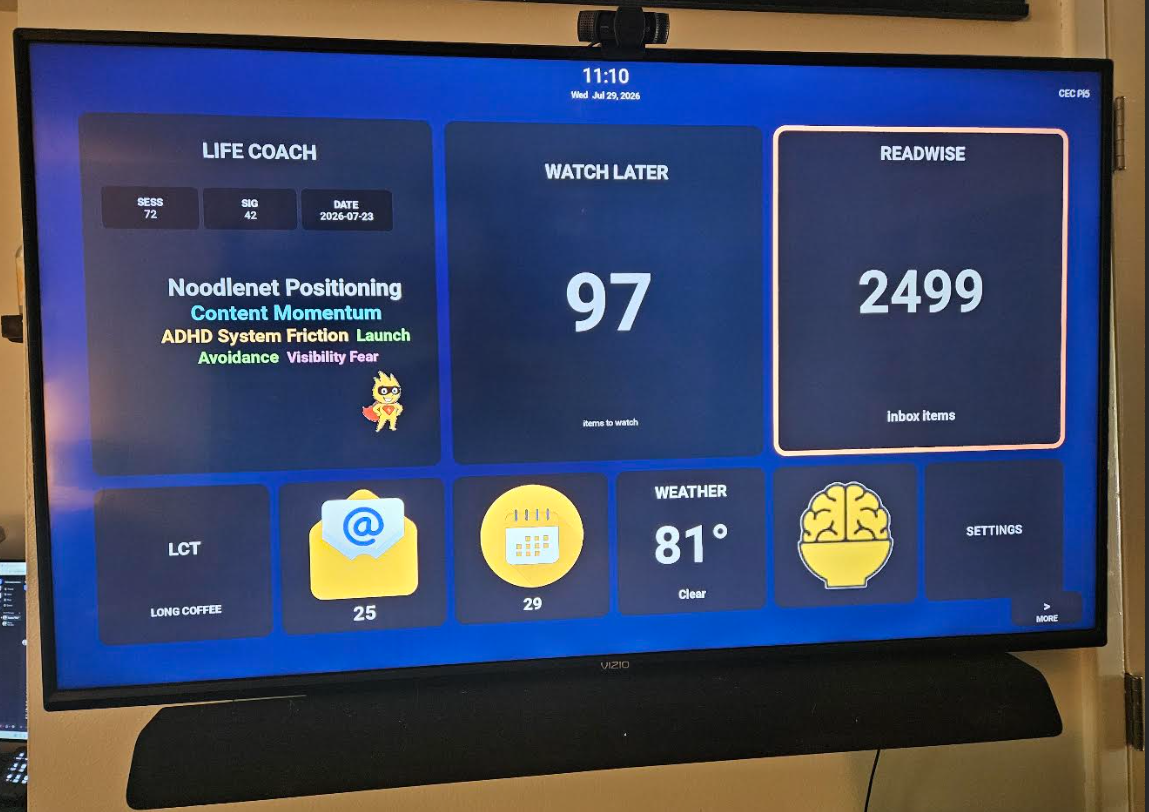
I started working on NoodleTV-think WebTV, but as a visual interface for NoodlePKM.
I always wanted a WebTV unit. I was apparently the one geek who had multiple computers and enough servers to make the house look like a small data center, yet still thought:
"You know what this needs? WebTV."
One of the hardest things for me is building for an actual need first.
My natural development methodology is usually:
1. Build seventeen interesting things. 2. Discover the original problem is still there. 3. Add a dashboard.
This time, I forced myself to behave.
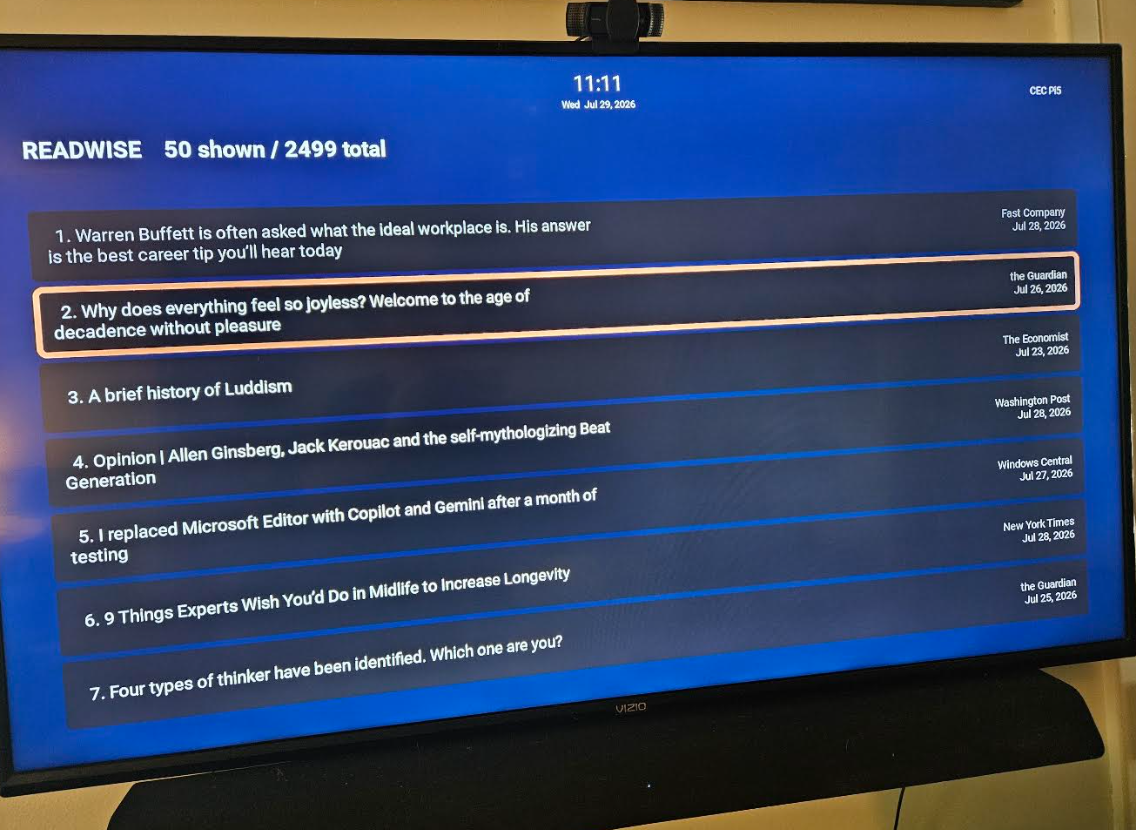
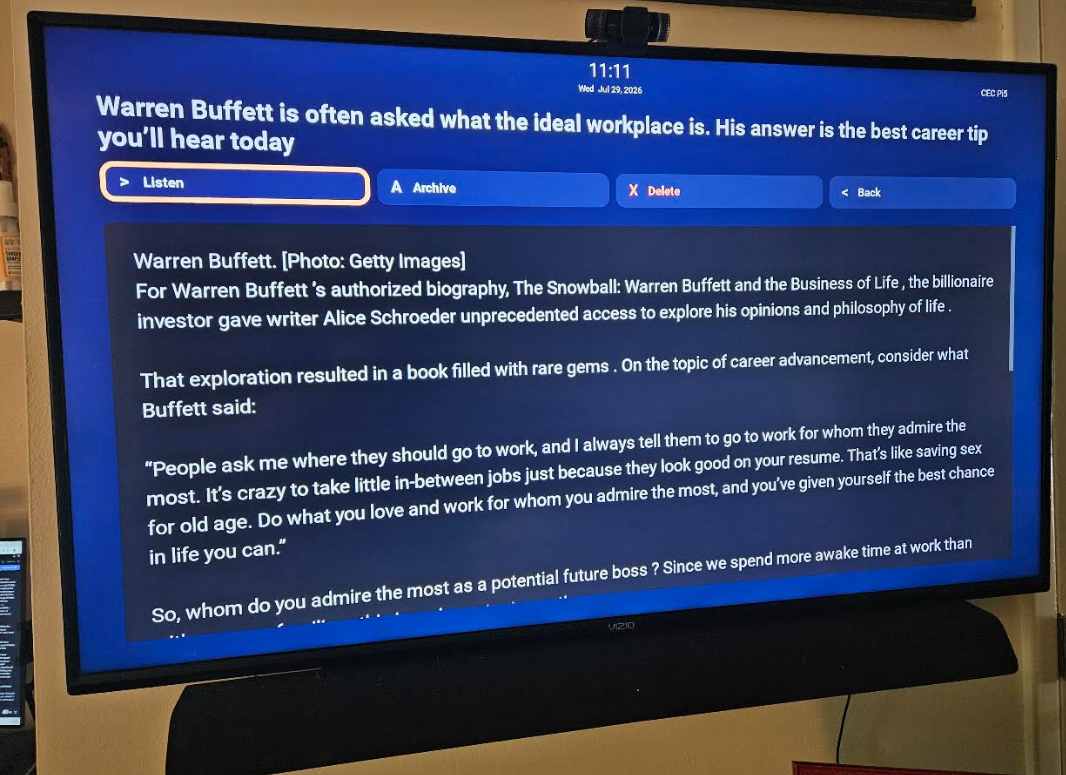
For NoodleTV to be useful, it needed an everyday purpose. That led to the Readwise gadget, complete with ElevenLabs integration so saved content could become something I could browse, hear and actually use.
But I still had one problem:
3,500 articles covering every subject my human noodle had found interesting over an entire year.
A little overwhelming.
This morning, while drinking coffee and reviewing the day's news feeds, I had a thought:
Why not ask Jenny to go through the Readwise archive and find all the vendor white papers, gated ebooks and download pages I had saved with the intention of revisiting later?
Jenny is my Girl Friday. She is also my oldest continuously running agent.
I had also been putting the finishing touches on Noodle Notes-imagine HyperCard crossed with an agent memory layer.
So I asked Jenny to review the Readwise items, identify the vendor resources that matched my criteria, summarize each one, preserve the links and useful context, and create a structured Noodle Notes memory object.
Then she removed those items from the Readwise queue.
Before I knew it, my Readwise list was more manageable.
But the cleanup was not the most important result.
The object you see on the left side of the screenshot is now part of NoodleNet's shared memory environment.
I can open it and read it with my human eyes.
More importantly, my agents can understand it, reference it and use it as part of future work.
Later, when I am writing an article, researching a technology or working with my agentic marketing team, that knowledge is already there.
No hunting.
No rebuilding the context.
No wondering where I saved something.
The information moved from a forgotten reading list into a shared working memory for both the human and the AI.
That is where I believe this is going.
The future of AI is not simply having a chatbot answer questions.
It is building environments where human judgment, agent capability and organizational memory naturally flow together-each doing the part it does best.
That is the future of the AI operating system.
And quietly, one strange little workflow at a time, that is what I have been building with NoodleNet.