

What does it really cost to produce content that sounds like the founder?
Once you price voice capture, revisions, social repurposing, publishing, and AI-search adaptation together, the real cost looks more like an operator role than a cheap writing task.
Once a small business stops pretending content is a cheap administrative task, the budget becomes easier to understand.
The request sounds simple when it is compressed into one sentence:
Write a strong article, turn it into social posts, publish everything, and make sure the work is ready for search and AI answer engines.
That sentence is not one deliverable. It is a small operating system.
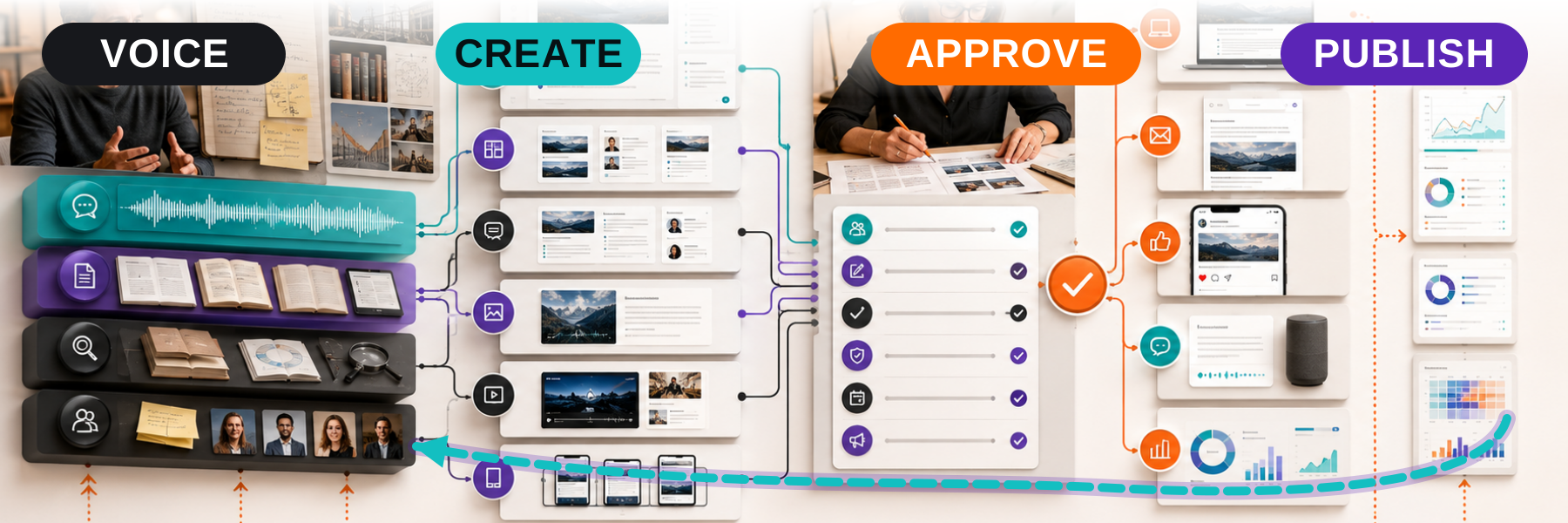
It includes source capture, subject-matter interpretation, editorial positioning, writing, revision management, channel adaptation, visual direction, metadata, quality assurance, human approval, publishing, and measurement. If the content must genuinely sound like the founder, someone also has to learn how that founder makes decisions—not merely imitate a few phrases.
This is why price comparisons become confusing. A buyer asks for “content,” but proposals may price entirely different units of work.
One provider prices a draft. Another prices a finished article. Another prices a managed monthly workflow. All three numbers can be legitimate while describing different levels of ownership.
The useful question is not “What does a blog post cost?” It is “What must be owned before this idea can represent the business in public?”
Start by defining the unit you are buying
There are four common units in the small-business content market.
1. The draft
The provider turns a brief into words. The buyer supplies the angle, source material, examples, fact checking, approval, repurposing, and publication.
This is the least expensive unit because most operating responsibility remains inside the business.
2. The finished asset
The provider conducts light research, develops the article, incorporates revisions, and delivers a publication-ready file. The business still owns channel adaptation, scheduling, site formatting, final QA, and measurement.
3. The campaign package
One approved source asset becomes a coordinated set of channel-specific outputs: article, newsletter section, social posts, sales enablement excerpts, or answer-focused content. The provider may also own the calendar and publishing preparation.
4. The content operating system
The provider or internal operator owns the path from source knowledge through approval, publication, and learning. The business retains decision authority while the system retains context, state, and accountability.
Comparing the price of the first unit with the fourth is like comparing a set of architectural drawings with a managed construction project. Both matter. They are not the same purchase.
Public rate cards explain only part of the market
Public marketplaces are useful for establishing a floor, but they are easy to misread.
Upwork’s current hiring guides show broad historical marketplace ranges of roughly $15–$40 per hour for content writers and $14–$35 per hour for social media managers. Those global ranges include narrowly scoped execution work and do not represent the price of a senior operator owning strategy, source capture, approvals, multi-channel publishing, and quality control.
At the other end of the comparison, the U.S. Bureau of Labor Statistics reports a May 2025 median annual wage of $166,790 for marketing managers. That employee benchmark is not a freelance rate, but it demonstrates the market value assigned to experienced marketing judgment and accountability.
Neither number tells a small business what its exact program should cost. Together they explain why a cheap writing quote and a managed content system can be separated by thousands of dollars without either number being fraudulent.
The gap is ownership.
A practical way to model the monthly workload
Consider a modest expertise-led program:
- one substantive founder-sounding article
- eight to twelve channel-specific social assets
- one newsletter adaptation
- publication across three or four owned and social surfaces
- two structured review points
- light search, answer-engine, and metadata work
- a short performance and learning review
Even at that scale, the work can reasonably include:
- Source capture and direction: interview preparation, conversation, transcript review, source gathering, and angle approval
- Core asset development: outline, drafting, evidence checks, examples, editing, and revisions
- Adaptation: social, newsletter, sales, and website variants built from the approved source
- Operations: links, formatting, metadata, image handling, scheduling, permissions, and publishing QA
- Governance: tracking review status, resolving changes, retaining the approved version, and preventing unapproved release
- Learning: recording what shipped, what questions it answered, and what the next cycle should use
A low-complexity month may require 20–30 focused hours. A research-heavy subject, several stakeholders, regulated claims, multiple channels, or an immature source library can push the work well beyond 40 hours.
The business should budget against that scope—not against the time required to type 1,500 words.
Useful planning bands for a small business
These are scenario bands for planning, not a universal rate card or a survey of every provider. Geography, industry risk, research burden, channel count, visual production, and cadence can move the number materially.
$800–$1,800 per month: execution support
This can work when the business already has strong briefs, documented voice, approved source material, and an internal owner. The provider may draft, format, schedule, or perform light repurposing.
What the buyer should not assume: independent strategy, deep voice capture, substantive fact checking, cross-channel governance, or end-to-end ownership.
$2,500–$6,000 per month: senior independent operator
This is a more realistic planning range for the modest program described above when one experienced person owns source capture, a strong core article, thoughtful repurposing, review coordination, and clean publication.
The lower end requires a disciplined cadence, accessible subject-matter experts, and limited channel complexity. The upper end can support deeper research, stronger editorial development, more formats, or more hands-on operations.
$5,000–$12,000 per month: boutique managed system
This level may include separate editorial, design, search, and publishing capabilities under one accountable lead. It becomes useful when the company needs higher volume, stronger visual production, multiple stakeholders, or a more complete measurement loop.
The value should come from coordinated ownership—not merely from adding more people to meetings.
$10,000+ per month: executive thought-leadership engine
This can include original research, frequent interviews, executive positioning, multi-format production, proactive distribution, analytics, and senior strategic counsel. It is appropriate when thought leadership is a material growth channel and the organization can use the output.
It is unnecessary for many small businesses. A smaller, governed system that consistently ships trusted work will outperform an ambitious package the team cannot feed or approve.
The quote is only half of the cost equation
The vendor invoice is visible. The operating drag inside the business is not.
Account for:
- founder hours spent reconstructing the brief
- late rewrites caused by direction being approved too late
- team time spent locating the current version
- channel assets rebuilt from inconsistent drafts
- publication delays while ownership remains unclear
- approved ideas that never become reusable source material
- reputational risk from generic, inaccurate, or unapproved claims
A $1,200 monthly service that consumes ten senior hours and rarely publishes can be more expensive than a $4,000 system that requires one focused approval session and ships reliable work.
The goal is not to justify the highest price. It is to compare total cost against delivered operating relief.
What a complete proposal should make explicit
Before comparing prices, ask every provider to define the same dimensions.
Source and strategy
- Who interviews the founder or subject-matter expert?
- How much source material is expected from the business?
- Does the provider recommend the angle or only execute it?
- Who verifies claims, examples, and external sources?
Production
- What counts as one core asset?
- How many revision rounds are included?
- Are channel versions genuinely adapted or mechanically shortened?
- Are visuals, accessibility text, metadata, and links included?
Approval and governance
- Where does review occur?
- Who records approval?
- Which version becomes the source of truth?
- What happens when a late change affects several outputs?
Publishing and measurement
- Which channels are included?
- Who formats, schedules, publishes, and checks the live result?
- Who monitors failures or missing assets?
- What reporting leads to a different decision next month?
A proposal that cannot answer those questions may still offer good writing. It is not yet pricing a complete operating system.
Where AI should lower cost—and where it should not
AI can reduce the cost of transcription, source organization, structural drafting, format adaptation, metadata preparation, and routine quality checks. A well-designed system should benefit from those efficiencies.
But AI should not erase the budget for accountable judgment.
Someone still has to decide whether the argument is true, whether the evidence is adequate, whether the tone fits the audience, whether the claim creates risk, and whether the asset is ready to represent the company.
The healthy economic model is not “AI makes content nearly free.” It is “AI lets a smaller expert team own more of the workflow without losing control.”
That is a meaningful reduction in coordination cost, especially for a founder-led business. It is not the elimination of expertise.
Where StoryShellOS fits
StoryShellOS is intended to reduce the operating burden between expert source material and an owned public presence.
It gives a small team a structured way to retain context, prepare assets with AI assistance, apply explicit human approval, publish through a controlled path, and keep the state behind the work. The system makes it easier to see what the business is buying and which part of the workflow remains its responsibility.
That does not make every content program inexpensive. It makes the cost more legible—and reduces the expensive pattern of paying for disconnected outputs while the founder continues to operate the system manually.
The decision behind the budget
The small-business buyer who understands the full scope stops asking, “Who can write this cheapest?”
They start asking:
- Which decisions must remain ours?
- Which operating work should disappear from our week?
- What will become easier to publish repeatedly?
- How will we know that the system is learning?
Those questions lead naturally to Part 3: the smarter purchase is not more disconnected freelancers. It is an approval-first content operating system.