
What does an AI-forward web-content operating rhythm look like?
The next generation of SMB websites will not be static brochures. They will be living content systems where AI helps turn everyday business knowledge into approved pages, posts, answers, and campaign surfaces.
The old website rhythm was broken.
Build the site. Launch the site. Ignore the site. Apologize for the site. Redesign the site.
Small businesses know this pattern too well.
The site starts with energy. Then the business changes. Offers shift. New questions come in. Better proof appears. The owner learns sharper language on sales calls. The market moves.
But the website sits there like nothing happened.
AI-forward web content changes the rhythm.
The website should learn from the business
Most SMBs already generate useful knowledge every week.
A prospect asks a good question. A client misunderstands the same thing three times. A project reveals a better way to explain the offer. A sales call surfaces a fear nobody addressed on the website. A support issue exposes a missing answer.
That is content.
Not in the fluffy sense.
In the business-asset sense.
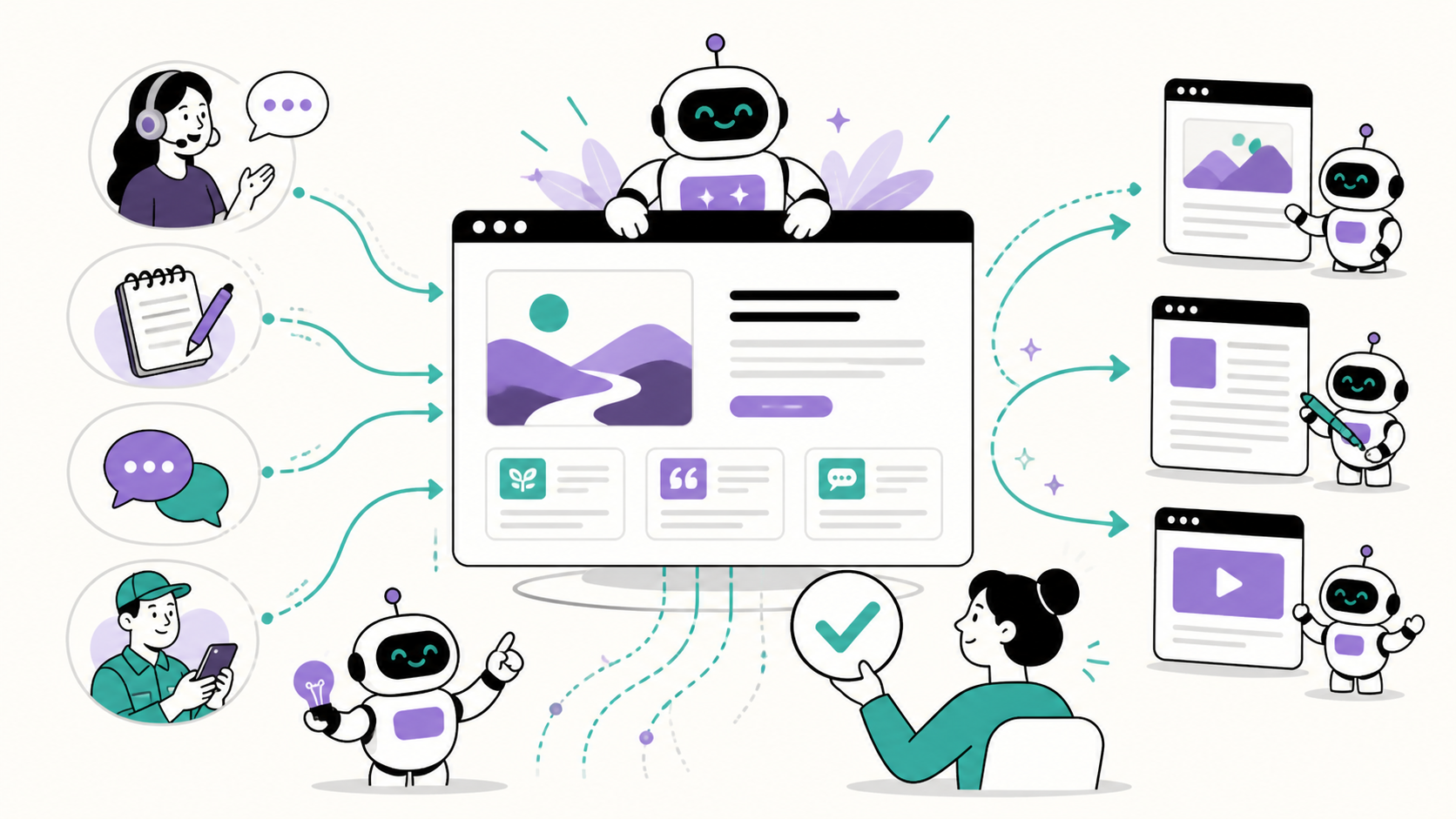
The future of web content is about turning those moments into public knowledge with less friction. AI can help gather, draft, compare, summarize, and prepare. Humans can approve, correct, sharpen, and decide what belongs on the public site.
That gives the website a rhythm closer to the actual business.
AI-forward does not mean AI-published
This distinction matters.
AI-forward content is not the same as letting a machine publish whatever it wants.
For SMBs, trust is too expensive to gamble with. The point is not to remove the human. The point is to stop making the human do every production step alone.
The owner should not have to turn one useful thought into five channel-ready assets by hand.
The operator should not have to rebuild the whole site every time the message improves.
The business should not need a full marketing department just to keep its owned content alive.
AI can prepare. Humans approve. The site publishes.
That is the operating rhythm.
Search is becoming answer-shaped
The future of web content is also being shaped by how people ask for help.
They want direct answers. They want comparisons. They want context. They want examples. They want enough confidence to believe the business understands the real problem.
Search engines and generative engines are moving in the same direction. They are trying to understand entities, relationships, expertise, and usefulness.
That means SMB websites need clearer structure.
They need pages and posts that explain what the business does, who it serves, what problems it solves, what tradeoffs matter, and how its point of view differs from generic advice.
That is hard to maintain manually.
It is exactly the kind of work AI can help prepare when the business has a governed publishing system.
The SMB advantage is real voice
Large companies often have more content.
Small businesses often have more real voice.
That is the advantage.
The owner knows what prospects are afraid of. The team knows what actually breaks. The service provider knows which advice sounds good but fails in the field.
AI-forward content lets that knowledge travel farther.
Not by flattening it into generic copy.
By turning it into a repeatable flow: capture the raw material, shape it into useful public content, approve it, publish it, and keep improving it as the business learns.
That is why the future of web content is not a bigger pile of posts.
It is a smarter publishing rhythm.
For SMBs, that rhythm may become one of the most important marketing advantages they have.