
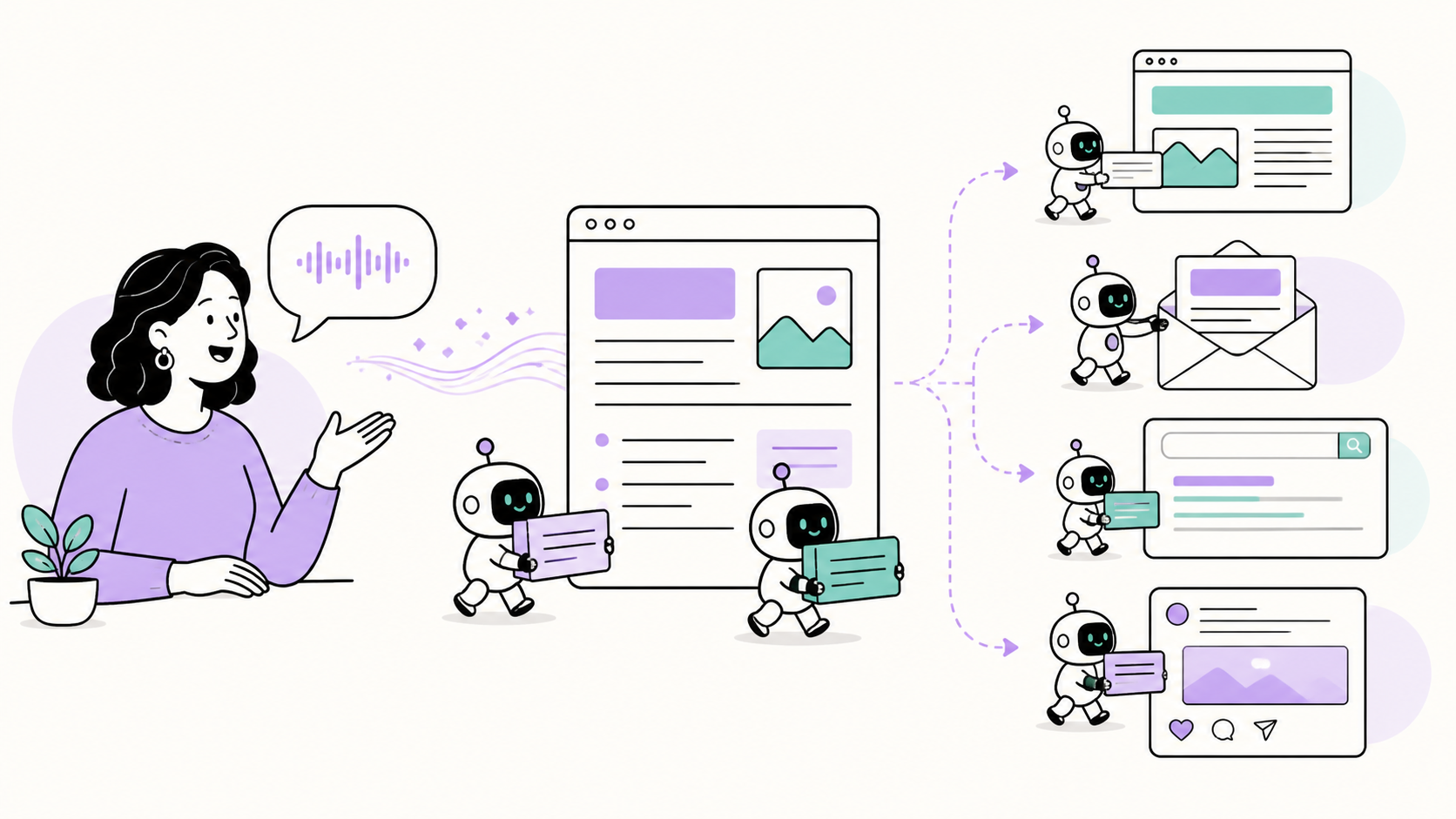
How can AI help a founder's voice travel farther without making it generic?
For expertise-led SMBs, AI-forward content is not about replacing the owner voice. It is about turning that voice into owned web assets that can show up across the places buyers actually look.
The future of web content is not more content.
That sounds annoying until you look at what most small businesses are actually dealing with.
They already have ideas. They have opinions. They have client stories, field notes, sales calls, objections, half-written explanations, and the kind of practical judgment that only comes from doing the work for years.
The problem is not the raw material.
The problem is getting that material out of the owner's head and into places where buyers, search engines, and AI answer engines can understand it.
That is where AI-forward content starts to matter.
Your voice used to be trapped
Before AI, most SMB publishing broke in the same place.
The owner would say something smart on a call. Someone might write it down. Maybe it became a note. Maybe it became a social post. Maybe it disappeared forever because the business was busy and nobody had time to turn it into a page, a post, an FAQ, an email, and a sales follow-up.
That was normal.
It was also expensive.
The business had a voice, but the web only saw a tiny slice of it.
AI changes that if it is used correctly. It can help capture the voice, shape the raw idea, pull out the useful distinctions, and prepare multiple versions for different channels.
Not because every channel needs the same message copied and pasted.
Because every channel needs the same business truth translated for its own job.
Owned content becomes the source
For an SMB, the website should be the source of record.
Not Instagram. Not LinkedIn. Not a newsletter platform. Not a random AI chat history.
Those channels matter, but they should point back to owned content that the business controls. The site should hold the clearest version of the answer. Then the business can turn that answer into a short post, a client email, a sales note, a video script, or an answer-engine-friendly FAQ.
That is the AI-forward part.
The website stops being a brochure and starts becoming a structured knowledge base for public trust.
The human voice still has to lead
This is where a lot of AI content goes wrong.
It sounds like the business hired a machine to stand in the lobby and explain things with a plastic smile.
That is not the goal.
The useful version is human-led and AI-assisted. The owner brings the judgment. AI helps organize the material. A human reviews what should be published. The site becomes more useful without turning into a content mill.
For expertise-led SMBs, that is the difference between scale and slop.
Why this matters now
Buyers are changing how they search.
Some still use Google. Some ask ChatGPT. Some skim LinkedIn. Some look for proof on the site. Some want a direct answer before they ever talk to a salesperson.
That means your expertise has to be findable in more than one place.
But it also has to sound like you.
AI-forward content gives small businesses a practical way to do that. One real idea can become a web page, a field note, a short answer, a FAQ block, a social post, and a sales follow-up without asking the owner to become the production department.
That was not realistically available to most SMBs before.
Now it is.
The businesses that win will not be the ones publishing the most noise. They will be the ones turning real expertise into clear owned content, then carrying that voice into every channel where the right buyer is already asking questions.