The useful part of AI publishing is not that one prompt can turn into one article.
That is the easy demo.
The more interesting test is whether the same raw human experience can become different public work for different audiences without flattening into the same article wearing a new hat.
That is what happened with the TEDx Raleigh second-brain notes.
One human went to the event. One notebook absorbed the chaos. The notes were messy, partial, fast, and occasionally dramatic enough that even the OCR looked like it wanted a short break. Then the agent marketing team took the same underlying material and produced two published articles with different jobs.
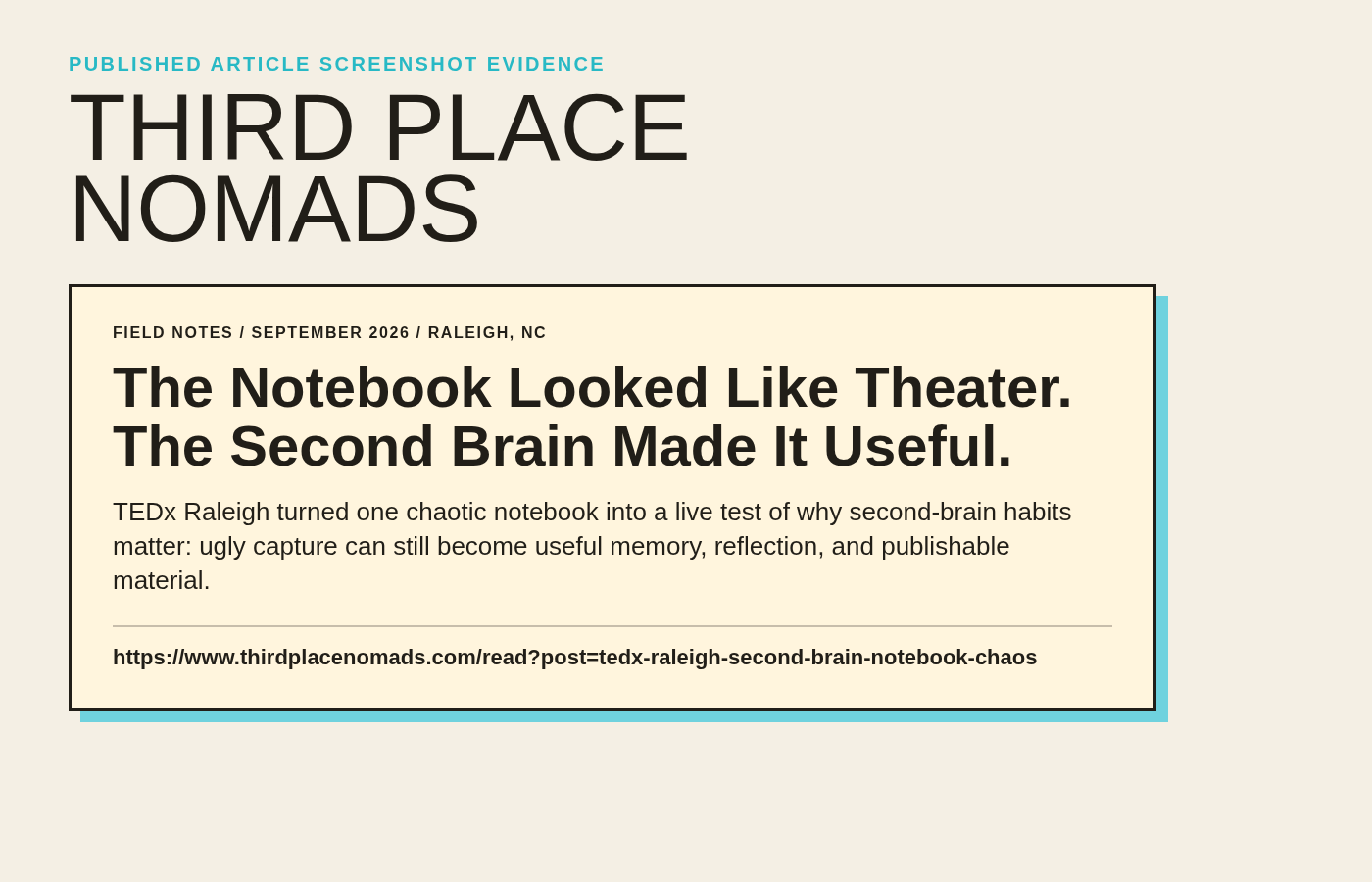
Third Place Nomads got the lived-experience version.
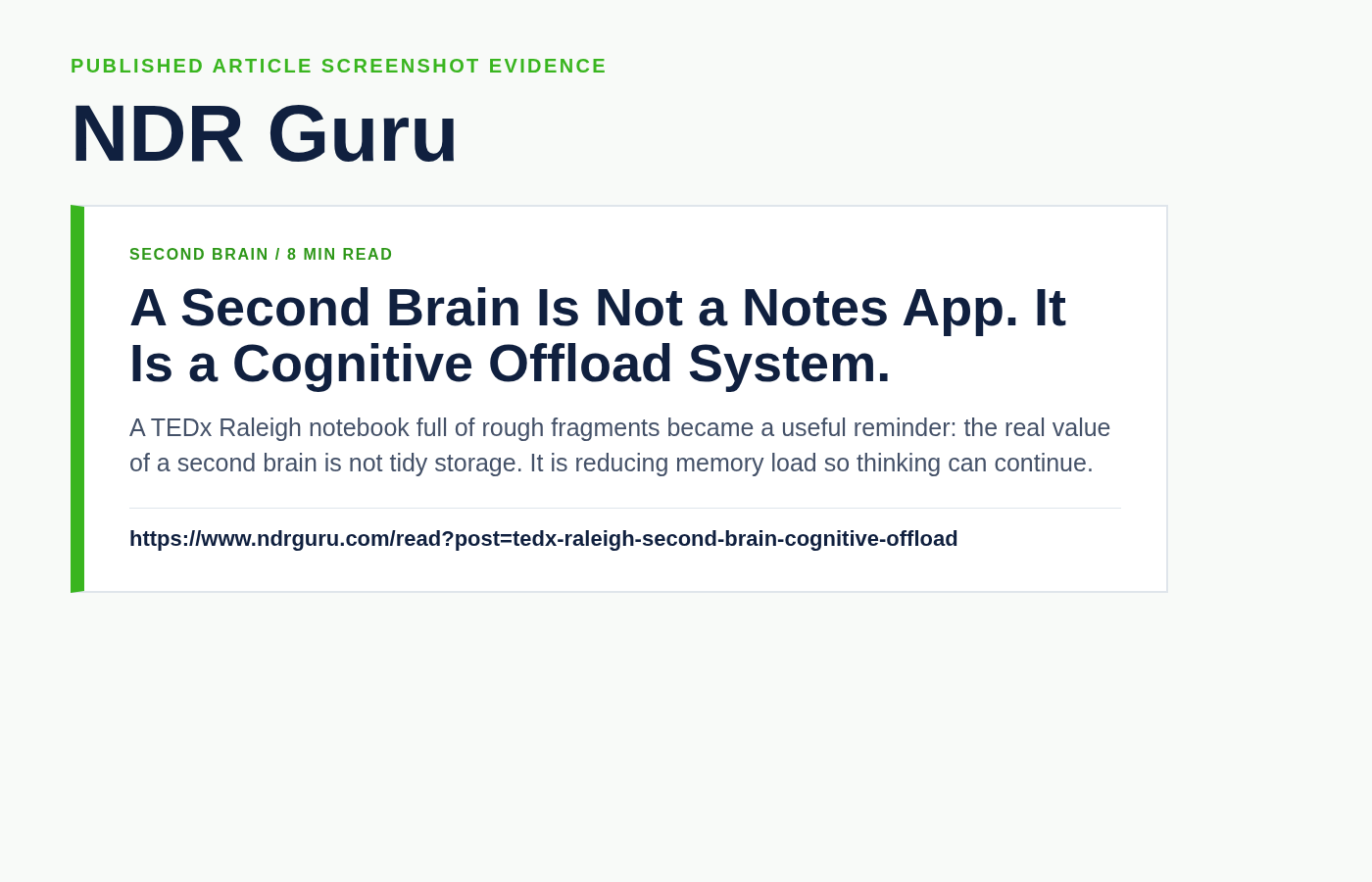
NDR Guru got the structured second-brain version.
Same source. Different editorial decisions. Different reader promise.
That is the part worth paying attention to.
The raw material was not clean
The source material was not a polished essay waiting to be copied.
It was an event notebook. That means fragments, speaker impressions, half-legible lines, emotional residue, useful phrases, and enough spelling turbulence to make the page look like theater.
In normal content work, that kind of raw material often gets lost. The next day arrives. The spark fades. The notebook goes onto a desk, then into a bag, then into the private museum of things a person definitely meant to process later.
The second-brain habit changed the outcome.
The point was not perfect capture. The point was recoverable capture.
Once the rough notes were inside a workflow, the system could preserve the energy of the event, separate signal from scribble, and turn the experience into material a publishing team could actually use.
The agents did not rewrite the same post twice
This is where the workflow becomes a StoryShellOS story.
The agents were not asked to take one draft and spin it into two lightly different versions. They were given the same underlying human experience, then asked to publish for two different sites.
That requires judgment.
For Third Place Nomads, the right angle was personal and observational. The piece had to feel like someone had been there, notebook in hand, noticing the absurdity and usefulness at the same time. It made room for the funny visual contrast: the notebook looked theatrical, but the real lesson was practical. Ugly notes are still useful if the capture habit exists.
For NDR Guru, the right angle was more structured. The article explained cognitive offloading, metacognition, and memory load in plain language. It treated the same notebook chaos as evidence for how a second brain actually works: not as storage for tidy notes, but as a system for reducing mental load so thinking can continue.
Those are not cosmetic differences.
They are editorial differences.
Audience is part of the system
This is the quiet discipline that separates a useful AI-managed publishing operation from generic content generation.
The system has to know where the work is going.
Third Place Nomads can be funny, specific, and human in a field-note way. It can talk about the notebook looking like a prop from an experimental play and still land the practical point: the event gave more back because the notes became usable.
NDR Guru has a different obligation. It needs to explain the mechanism. It can use bigger terms, but it has to translate them. Cognitive offloading means moving memory work out of your head and into a trusted system. Metacognition means thinking about your thinking. Reduced cognitive load means your brain has fewer sticky notes fighting for attention.
Same experience.
Different reader.
Different shape.
The agent team respected that.
The handoff made the work look like work
There is another proof point here that matters more than it first appears.
The cleaned task handoff turned the messy source story into an organized operating artifact.
That matters because people trust systems they can inspect. A good handoff shows the assignment, the core angle, the evidence, the required visuals, and the reason the work matters. It makes the human look organized because the workflow is organized.
In agent-assisted publishing, that is not a cosmetic detail.
It is how the operation avoids drifting into "I asked AI to make something and hoped for the best."
What this proves
This was a compact but strong demonstration of the publishing operation Jimmy has been building.
It proved that a human experience can be captured while it is still fresh.
It proved that messy notes can become useful source material instead of disappearing into a notebook.
It proved that agents can make brand-aware editorial choices when the workflow gives them enough context.
It proved that the publishing system can move from raw human signal to site-specific public output while keeping the chain visible.
And it proved something more important than volume:
Good AI publishing is not about making more versions of the same thing.
It is about helping the right idea become the right artifact for the right audience.
Read the two source articles
The two published pieces show the audience split clearly:
- Third Place Nomads: The Notebook Looked Like Theater. The Second Brain Made It Useful.
- NDR Guru: A Second Brain Is Not a Notes App. It Is a Cognitive Offload System.
The best part is that neither post needed to pretend the notebook was elegant.
The notebook was the point.
The system made it useful.