AI slop is usually described as a writing problem.
The sentences are generic. The examples feel borrowed. The claims sound confident but cannot survive a follow-up question. The article exists because publishing became easy, not because the business had something useful to say.
That description is accurate, but incomplete.
AI slop is also an operating problem.
It is what happens when a publishing system has no dependable source material, no clear job for the content, no accountable owner, and no approval gate between “generated” and “live.”
AI did not create those missing pieces. It simply made their absence much easier to scale.
What is AI slop? AI slop is low-value material produced and published without enough original knowledge, verification, purpose, or human judgment to make it trustworthy or useful.
Did AI invent low-value business content?
No.
Businesses were publishing thin articles, padded introductions, interchangeable service pages, and search-shaped filler long before generative AI arrived. The old process was slower because somebody still had to type the words, move them through a document, and paste them into a content management system.
That friction limited the volume. It did not guarantee the quality.
Generative AI changed the production economics. A team can now create ten drafts in the time it once took to create one. That can be extremely useful when the system begins with real expertise and ends with informed review.
It is destructive when the system treats the existence of a draft as proof that something deserves to be published.
The problem is not that a machine helped prepare the words.
The problem is that nobody can answer why those words exist.
Why does generic content fail faster now?
Generic information is abundant. AI assistants can summarize it, compare it, and answer routine questions without sending a person through five nearly identical articles.
That changes the value of a business website.
A site cannot rely on making the visitor work harder than necessary to find a simple answer. It needs to become a useful source: a place where the business’s experience, methods, proof, decisions, and point of view accumulate over time.
This is especially important for founder-led businesses and experts. Their advantage has never been the ability to produce the most words. It is knowing what the generic answer misses.
A roofer knows which symptoms change an inspection from routine to urgent. A consultant knows which “best practice” fails when a team reaches a certain size. A financial professional knows which assumption makes a neat projection misleading. An agency knows which handoff quietly adds three weeks to a launch.
That knowledge is the signal.
AI can help capture it, organize it, question it, and shape it into a useful public asset. AI cannot invent the years of experience that made the observation valuable.
What should a business publish instead of more filler?
Publish evidence of how the business thinks.
That can include:
- a direct answer to a question customers repeatedly ask;
- an explanation of a decision and the tradeoffs behind it;
- a lesson learned from a real project;
- a case example with enough context to be useful;
- a checklist the team actually uses;
- a strong opinion supported by experience;
- a calculation, assessment, or diagnostic that helps someone act;
- an update to an existing page when the better answer belongs there.
Not everything should become a blog post.
Sometimes the most useful format is a revised service page, a short FAQ, an email, a comparison table, a field guide, or a small interactive tool. Sometimes your best content is software.
The format should follow the job.
If the audience needs an explanation, write the explanation. If they need to estimate something, give them a calculator. If they need to understand where they stand, build an assessment. If the correct answer depends on context, do not flatten it into a universal claim just because universal claims are easier to generate.
Where should human approval sit?
Human approval should sit at the point where prepared material becomes an official statement from the business.
That does not mean a founder needs to rewrite every sentence. It means someone with the right context can see the staged version, verify the substance, make corrections, and deliberately approve publication.
The reviewer should be able to answer four questions:
1. Is this grounded in something the business actually knows? 2. Is it useful to the audience it claims to serve? 3. Are the facts, examples, and promises accurate? 4. Should the business put its name on it?
If nobody owns those questions, adding a better model will not solve the problem.
It may produce smoother slop.
This is why approval-first content operations matter. AI can do substantial preparation. The system can handle formatting, metadata, links, images, and routing. But the boundary between preparation and publication should remain visible.
Speed becomes trustworthy when responsibility is clear.
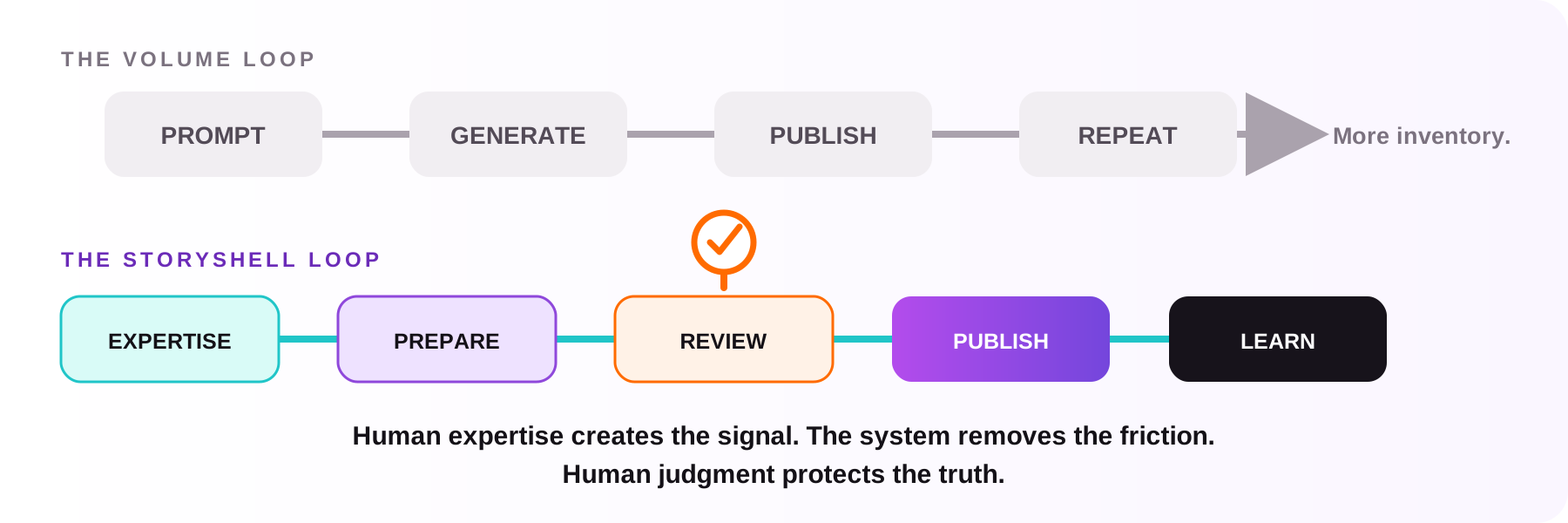
How does an owned publishing system reduce AI slop?
An owned publishing system makes the source and the decision path easier to preserve.
The raw material can begin as a call, voice note, workshop, customer question, spreadsheet, field observation, or internal document. That material stays connected to the draft. Requested changes remain attached to the work. The approved version becomes the version used for publication. The public page is not the only record of what happened.
That creates a better loop:
Business expertise → AI-assisted preparation → human review → controlled publication → new customer insight.
The insight from what people read, ask, calculate, or respond to can then improve the next piece of source material.
That is very different from opening a chatbot, asking for twenty SEO articles, and filling a calendar because the calendar looked empty.
One process compounds knowledge.
The other compounds inventory.
What is the practical test before content goes live?
Before publishing, ask:
What would disappear if our business were removed from this piece?
If the answer is “nothing,” the draft is probably too generic. Another company could change the logo and publish the same thing.
Then ask:
What can the reader understand, decide, or do after this that they could not do before?
If the answer is unclear, the content may not have a useful job.
Finally, ask:
Who verified it and approved it?
If nobody can answer, it is not ready to represent the business.
These questions are simple on purpose. A quality system should not require a committee meeting for every paragraph. It should make the important checks easy to see and hard to skip.
The answer is not less AI. It is better publishing.
AI can reduce the friction between what a business knows and what its audience can use. That is a meaningful capability.
But lower production cost is not the same thing as higher publishing value.
Human expertise creates the signal.
The system removes the friction.
Human judgment protects the truth.
StoryShellOS is being built around that division of labor: turn real business knowledge into staged public assets, keep approval visible, and publish through a controlled path. The goal is not to help a business feed the internet more words.
It is to help the business put more of what it genuinely knows to work.
Spend less time feeding the marketing machine and more time giving it something worth talking about.